

girls clothes |
- Trump's China tariffs will hit women's clothing more than men's - Quartzy
- The Mom Stop: Focus on learning, not clothes - Pratt Tribune
- How much LI families are spending on back-to-school - Newsday
- For kids' clothes, no one retailer has the lock on back-to-school season this year - CNBC
| Trump's China tariffs will hit women's clothing more than men's - Quartzy Posted: 26 Aug 2019 11:00 AM PDT  On Sept. 1, when the US is scheduled to impose a new 10% tariff on imports of select Chinese-made clothing and footwear, women will likely feel the impact more than men. The reason is that a much larger share of women's and girls' clothes and shoes imported into the US are made in China compared to men's equivalents. A Wall Street Journal analysis of data from the office of the US Trade Representative and the Census Bureau found that about 42% of women's and girls' clothes and shoes came from China in 2018, versus about 26% for men and boys. That translated to $23.5 billion worth of women's and girls' products, compared to just $10.9 billion for men and boys. To bring their products into the US, companies will have to pay the additional tariff. Typically they pass that cost on to consumers, who end up paying a higher retail price. In this case, women will probably see more price hikes than men. The new round of tariffs, which will cover a wide range of Chinese goods, will be US president Donald Trump's first to hit clothing and footwear imports. Women not only buy more clothing than men in the US, but the companies making the clothes generally rely more on China to produce them. That's because women's fashion tends to change more quickly than men's, and often requires more skill to efficiently produce. China has built up the specialized infrastructure and workforce to deliver on both speed and quality, which is why many fashion companies can find it difficult to shift their manufacturing out of the country even as wages have risen—and why more women's fashion than men's is made there. "If I was to make a basic men's jean, I'd make that in Pakistan," Edward Hertzman, founder and president of trade publication Sourcing Journal, previously told Quartz about the quality of China's fashion manufacturing. "If I was going to make a fashion woman's garment, I would move to China because their skill set is better, their hand is better, their finishing is better, and they can handle that type of fashion." (Incidentally, if the tariff Trump has threatened on Mexican imports ever became a reality, it would disproportionately hit men's blue jeans.) Even without the new tranche of tariffs, US clothing and footwear imports have historically incurred higher duties than other consumer goods. In this case, too, women are already paying a higher price than men. A 2018 report by the US international trade commission looking at tariffs on all clothing imports—not just those from China—found the average tariff collected on imports of men's clothing in 2016 was 12%. On women's apparel, it was 14.9%. This gap, it noted, had widened from a decade prior. Women can even shoulder higher tariffs on nearly identical products, as Katica Roy, CEO of Pipeline Equity Inc, a firm focused on unconscious bias in the workplace, recently pointed out to Bloomberg. On overalls, she noted, the US imposes a 14% tariff on the women's version and a 9% tariff on the men's. On hiking boots, the women's version gets a 10% tariff, while the men's gets a duty of 8.5%. The gender gap in tariffs only seems set to widen.  |
| The Mom Stop: Focus on learning, not clothes - Pratt Tribune Posted: 27 Aug 2019 07:53 AM PDT Dress codes are misfortunate for many awkward, growing kids - specifically for girls. At 13 or 14, I hadn't yet reached my full 6-foot height and yet my feet were already the size of small submarines and my arms and legs were like long, lanky noodles. It took a few years for my painfully short torso to catch up with the rest of me. I now pity my mother, who had the challenge of finding shorts that were long enough so that they were 2 inches below my fingers. My arms were so long in junior high, I'm pretty sure they touched my knees. We'd buy my clothes at the mall and then my grandmother, who was a talented seamstress, would let out seams as far as they would go. There were a few times when we'd buy pants, only to cut them off at a short length but long enough to wear to school. Finding clothing for growing, lanky children isn't easy. It's even harder with today's strict dress codes that, whether purposely or not, can unfairly target female students. It was at an intermediate school in Madison County, Alabama, last week that the principal called out over the intercom for all female students to stand up in class to make sure that they were abiding by the dress code. The boys remained seated. One student, a tall, long-legged 9-year-old daughter of a friend of mine, was called to the front of the class and was later sent home with a warning because her fingertips extended below the length of her shorts. Another female student, who was wearing a long shirt with leggings, was also given a warning, but because her shirt was not long enough. If she had been wearing jeans, she would have been fine, but not that day, due to the leggings. These girls are in fourth grade. They are children. Not objects to be sexualized or put through public shaming. But unfortunately, that is what dress codes, and specifically a call for only girls to stand up, does. It makes them objects and prioritizes the length of their shorts over their own education. It sends a message that when girls are not appropriately "covered" - that they are at fault. But for what? It also teaches boys that the rules don't necessarily apply to them. It puts emphasis that girls are objects of distraction, and thus the girls must comply, despite their awkwardly growing bodies and the fact that they aren't yet even 10. Unfortunately, these dress code incidents happen all too frequently across the country. Instead of emphasizing education in the classroom, the focus is instead switched to what our children are wearing, instead of what they are learning. There is a place for dress codes, but children should never be called out. Rather than unfairly penalizing a specific sex, race or religious group based on what they wear, policies should be inclusive and neutral. That was the focus of a new dress code policy approved July 11 by the Roanoke County School Board in Roanoke, Virginia. As part of the approval process, 1,370 parents voted on the new code, which had a 59% approval rating. The previous dress code could be perceived as targeting female students, said Don Butzer, Roanoke County Schools board chairman, with language like "undergarments (including bra straps), cleavage or midriffs should not be exposed," and "short/skirt length should be no higher than mid-thigh." The banned clothing list included the words "shirts with spaghetti straps." But, the new policy is more gender-neutral, requiring "tops must have shoulder straps" and clothing must "cover areas from one armpit across to the other armpit, down to approximately 3 to 4 inches in length on the upper thighs." Butzer called the new dress code one of the "most progressive, non-gender-biased dress codes in the state," according to the Roanoke Times. There is a need for dress codes and an appropriate use for them. But, as the mom of two daughters and a son, it makes me more than grateful that dress codes have never been discussed at my kids' elementary school, outside of a reference in a parenting handbook. If my daughter had been called to stand while boys remained seated, I would be banging on the door of the superintendent to complain. But luckily, some school systems are more progressive than others. For those with antiquated policies, I hope they change. Schools should focus on being as inclusive as possible, and always, the focus should be on education.  |
| How much LI families are spending on back-to-school - Newsday Posted: 27 Aug 2019 04:23 AM PDT During back-to-school season (that would be now), organizations and companies survey U.S. families to try to gauge what they plan to spend per child on items such as clothing, shoes, electronics and school supplies. This year, the results range from $221 per child nationwide predicted by the coupons website Promocodes.com, to $722 per child spent specifically by New Yorkers, according to the consulting firm Deloitte. No matter how you measure it, one thing is clear: Parents are dropping a chunk of change. According to the National Retail Federation, this year will be record-breaking, both for families with students in grades K to 12 and families with students in college. Here's how three families on Long Island meet their back-to-school needs: The ProtosMEET THE FAMILY Sandra Proto, 52, a stay-at-home mother from Valley Stream, her husband, Robert, 49, who works for Social Security, and daughters Alberta, 12, a rising eighth-grader, and Nicole, 11, a rising seventh-grader. SPENDING ESTIMATE $500 to $550 on each child. CLOTHES First Sandra Proto goes through the girls' clothes with them to see what still fits, and then they shop to fill in needs. "As they've been getting older, their taste has changed on which stores they would like to go to," Proto says. They're now hitting H & M and Old Navy instead of Justice or Children's Place. "It becomes more expensive," Proto says. She can't get away with handing down clothes from one to the other anymore. "The younger one may not want those clothes," she says. SHOES Both girls like Vans, and Alberta likes vintage boots. "If they want an expensive pair of sneakers, they'll pay out of their money for that, birthday money or Christmas money," Proto says. ELECTRONICS Both girls have phones already, and they share the house computer. Proto isn't supplying them each with a laptop at this point, she says. SCHOOL SUPPLIES "As far as school supplies, I'm very happy," Proto says. "Now that they're in junior high school, the list is cut. It's minimal." The AbramsMEET THE FAMILY Lisa Abrams, 48, a stay-at-home mother, and her husband Steven, 49, a sales manager, of East Northport. They have nine children. Three are in college: Gabrielle, 21, a rising senior at Marist College, Zachary, 19, a rising sophomore at Binghamton University, and Matthew, 18, about to begin his first year at SUNY Cortland. Two are in high school: Cameron, 16, a rising junior, and Brayden, 14, a rising freshman. The others are Chase, 12, a rising eighth grader, Payton, 11, a rising sixth-grader, Landon, 9, a rising fourth-grader, and Raelyn, 7, a rising second-grader. SPENDING ESTIMATE Maybe $400 per child — more for the college kids. Abrams says she won't even begin shopping for clothing for the younger ones, for instance, until all the older ones have left for college. COLLEGE SUPPLIES "I have one daughter who thinks she's furnishing a penthouse apartment, and my son who just asked for contact lenses and toothpaste," jokes Abrams. "She wanted us to take another car [for all her things]. She seriously has artwork on her walls and she needs 20 pillows." Zachary, on the other hand, came home with all the supplies she sent him with last year, such as Clorox wipes and Costco-sized boxes of snacks. "That's how I'm used to buying stuff," Abrams says. "I buy cases." ELECTRONICS "This year, my son Matthew got a laptop," says Abrams. "That was 1,500 bucks. It's almost worse than Christmas shopping." SCHOOL SUPPLIES "That became ridiculous," Abrams says. "My kids need 6,000 pencils for the first day of school. I felt like we were sharpening pencils forever. My little treat for myself is an electric pencil sharpener. We use it like somebody who is running a big office building." It's especially frustrating when a teacher asks for a certain brand, Abrams says. "This pencil writes just as good as that," she says. She doesn't send the kids with everything the teachers ask for on the first day, she says. For instance, if the list asks for six glue sticks, she will send the kids with half to start out. The GoelsMEET THE FAMILY Anubha Goel, 38, a physical therapist, her husband, Ashish, 41, a software professional, of Plainview, and daughters Ojasvi, 9, a rising fifth-grader, and Vanya, 5, a rising first-grader, both in elementary school. SPENDING ESTIMATE $100 to $150 maximum on each child this year. CLOTHES "Clothes we do little by little, whenever I see good deals," Anubha Goel says. "We go to Justice, we go to Target, I even picked up a few cute things from Costco." SHOES "I find shoe shopping for back to school the biggest struggle," she says. "The girls are picky. My kids like Merrells [brand shoes]." She shops for them online. "I try to look for deals but I haven't found any yet." ELECTRONICS "My older one will get a Chromebook from the school, so I don't have to spend money on that," Goel says. As for the younger daughter: "We don't indulge in all those things yet. She's younger, and we try to limit screen time." SCHOOL SUPPLIES Goel went through leftovers from last school year before shopping for more. "We don't have too much to buy this year," she says. Marshalls was running a great promotion on backpacks, she says, and the girls each picked out a backpack and lunch box there. 90 minutes in the mall = $178.50The battle of the jeans ended in a draw. Nicole Proto, 11, a rising seventh- grader from Valley Stream, was determined to get a pair of jeans with rips in them during her first back-to-school shopping trip of the summer with mother Sandra and older sister Alberta, 12, a rising eighth-grader. "It's different from regular jeans because it gives them style," Nicole argued. Alberta explained her parents' opposition to them: "They think it's kind of inappropriate. They think it shows too much skin." After Nicole tried on several pairs of jeans at Tillys in Roosevelt Field mall in Garden City, Sandra Proto agreed Nicole could buy one pair with rips and one pair without, in part because of an appealing "Buy-One-Get-One-Half-Price" sale on the $29.99 pants. But Nicole may have to agree to wear leggings under the jeans with rips, Sandra warned. During one 90-minute trip to the mall, Proto spent $178.50 on the clothing for the girls. Nicole's jeans were $47.06 at Tillys; each girl got a black sweater with a small, silver Mickey Mouse ears icon in the corner for a total of $20.09 at H & M, and both girls got a pair of black leggings and a knit sweater at Garage for a total of $111.35. Proto's pocketbook benefitted from buy-one-get-one-half price at both Tillys and Garage. The biggest challenge of back-to-school clothes shopping: "Trying to figure out what they need as opposed to what they want," Proto says. "They want everything." She's hoping to keep overall spending to $1,100 total. Still on the list of needs for the girls: shoes and sneakers and school supplies.  Beth Whitehouse writes about families, parenting and great things to do with the kids on Long Island. She's been a Newsday editor and shared a 1997 Newsday staff Pulitzer Prize for coverage of the crash of TWA Flight 800.  |
| For kids' clothes, no one retailer has the lock on back-to-school season this year - CNBC Posted: 08 Aug 2019 12:00 AM PDT  Pedestrians walk past a Gymboree store in San Francisco, California. David Paul Morris | Bloomberg | Getty Images Rachel Szylar, a stay-at-home mom of three kids in New Jersey, has shopped at now-bankrupted Gymboree and Children's Place before. But this year, she's planning to venture to big-box retailers Kohl's, Target and Walmart to pick up graphic tees, polo tops, dresses and denim for her 10-year-old son, seven- and two-year-old daughters. The summer is wrapping up, and so thoughts are turning from swim parties and sleep-away camps to getting ready for a new school year. Szylar said she also might do a little shopping online. "It's hard to bring all the kids to the mall to get stuff," Szylar said about why she started going to the likes of Kohl's and Target. "Gymboree was also getting kind of expensive." It's the first back-to-school season since Gymboree filed for bankruptcy in January for a second time, this time shuttering its entire fleet of stores. Children's Place is closing dozens of stores but is also trying hard to fill Gymboree's void. There's Carter's, which also owns OshKosh B'gosh and sells a line of clothes exclusive to Amazon. Gap and Old Navy are two other popular back-to-school destinations. This year, Gap's portfolio of brands includes Janie & Jack, which it bought from Gymboree out of bankruptcy court. The upscale brand, which sells girls dresses for upwards of $69, still operates JanieandJack.com and more than 100 stores. Beyond that, parents are scanning the aisles in places like Target, Walmart and Kohl's. Department stores are expected to be the most-frequented stop this back-to-school season, according to a study by the National Retail Federation, with 53% of parents planning to go to places like Macy's, Nordstrom and J.C. Penney. Forty-five percent of NRF's 7,660 survey respondents said they plan to go to specific clothing stores.
Spending on back-to-school clothing this year will climb to $240 per family from $237 a year ago, according to the study. But spending on shoes is expected to fall slightly to $136 per family from $139. Department stores, however, have been struggling to keep merchandise fresh and stores exciting, opening the door for Target and Walmart to sell more children's clothing. For many parents, Target and Walmart offer less-expensive alternatives to the likes of Macy's and other department stores, where a Nike-branded hoodie can cost $45 and a pair of jeans could retail for at least $22.50.
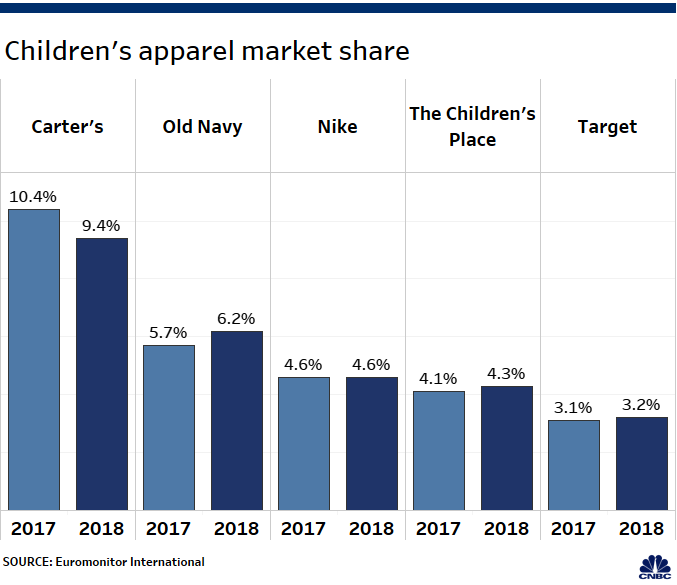
"People are looking to shop in the traditional venues a little bit less this year," Coresight Research analyst Marie Driscoll said. "Still, department stores are the first place they're going. But ... there are more alternatives." The children's clothing industry in the U.S. is valued at $33.9 billion, according to Euromonitor. But no one company has the majority of market share. Carter's ended 2018 with the biggest stake, 9.4%, which also includes sales of its apparel for newborns and infants. Gap had 6.2%, Nike had 4.6%, Children's Place had 3.2%, and Target ended last year with a 3.2% share of the industry, Euromonitor said. The power of a private labelTarget has used its private labels to win over moms like Ashley Donde, a mother of two who works as a freelance journalist. Its quirky Cat & Jack clothing line, which makes pieces for infants and kids up to size 18, surpassed $2 billion in sales in one year. Under the Cat & Jack label, a graphic tee retails for $6, a knit dress is $9.99 and boys' and girls' denim is $8. "I don't like to spend a lot of money, so I do generally go between Target and Old Navy," said Donde, who lives in a suburb of Houston with her 10-year-old daughter and nine-year-old son. Like Szylar, she also steers clear of shopping malls and prefers to go to strip centers that aren't as crowded. Target has another kids line, skewed to elementary school, called Art Class. And in June it announced a tween-centric brand called More Than Magic that sells sequin bomber jackets, glitter-embellished active-wear and pink tank tops with slogans like "Be You" on the front. In stores, Target's apparel displays are "looking phenomenal," according to Driscoll, who's been visiting various retailers' stores ahead of the back-to-school season. "About a year ago, I noticed Target was merchandising more in a lifestyle way ... putting outfits together on mannequins ... creating stop-in-shops." When you're in the children's clothing area at Target today, it almost feels like you're in a Limited Too store, or Target's version of a Gymboree store, she said. It's both parents that are buying and the children that are buying. You're seeing kids having more influence on the purchases. Ryan Fisher A.T. Kearney Rival Walmart has incubated some of its own kids clothing brands as well. It launched Wonder Nation last year. It also has been working with Kidbox — a subscription-box company akin to Stitch Fix but focused solely on selling clothes for babies, girls and boys — to sell boxes on Walmart.com. One box retails for $48 and includes four to five items. But Walmart doesn't appear to have the same fashion clout as Target, which is known for being "cheap chic." "Sometimes for my two-year-old I buy certain things at Walmart," Szylar said. "Because she gets messy in pre-school, and Walmart seems to be affordable. You don't really care if she gets those things dirty." Analysts say Walmart has a leg up with its uniforms business, especially for parents on a strict budget. You can find a pack of two polo shirts for under $9. Khaki pants for girls were recently on sale for less than $6. YouTube's influenceFor the moms and dads who prefer to shop online, there are new options, but these tend to be more expensive. Online personal styling service Stitch Fix ventured into the kids category in 2018, with most items retailing for $10 to $35, according to its website. Another is Rocket of Awesome, which offers a subscription option for parents but also sells items a la carte and is about to open its first bricks-and-mortar shop, in New York. Rockets of Awesome says most items on its website retail for $16 to $38. Earlier this year, Rockets of Awesome landed a $12.5 million investment from Foot Locker to help it grow. Source: Rockets of Awesome "When we started this business, the red flag that said there was something really big here ... was the distinct disconnect I felt like the leading players had when understanding who their customer was," Rockets of Awesome founder Rachel Blumenthal said in a recent interview about why she started the business in 2016. "They didn't understand the modern mom — who the modern kid was. Kids are savvier than ever." With more kids having access to social media platforms at a younger age, even second and third graders are looking to influencers online — if they have access to YouTube or other social platforms — and their friends, to see what everyone is wearing. Kids are forming opinions earlier about how they want to be dressed. And retailers should be taking note of their tastes and how those are evolving, just like they do with older generations. "People want not just the brand, but the story around the brand," said Ryan Fisher, a partner in the consumer and retail practice of consultancy firm A.T. Kearney. "And it's both parents that are buying and the children that are buying. You're seeing kids having more influence on the purchases." The number of parents planning to shop online this year has dropped from a year ago, according to NRF's survey, with 48.8% of parents saying they plan to shop on the internet compared with 55.4% in 2018. Some of that decrease is believed to stem from the fact that more parents shopped even earlier, during Amazon's 48-hour Prime Day event in July. During Prime Day, Amazon touted deals on fashion, making it one of the most-discounted categories. Szylar turns to Amazon when she needs a quirky outfit for a field trip, or the Peppa Pig shirt one of her kids has been wanting. "My daughter loves to coordinate things," the mom of three said. "One time she had a planetarium trip and I found a dress [on Amazon] that had planets on it. With Amazon, it will come in the mail within a day or two. ... Sometimes it's hard to find certain things they want in stores."  |
| You are subscribed to email updates from "girls clothes" - Google News. To stop receiving these emails, you may unsubscribe now. | Email delivery powered by Google |
| Google, 1600 Amphitheatre Parkway, Mountain View, CA 94043, United States | |





0 Yorumlar